LLC Franchise Tax by State: Who Taxes an LLC That Earned Nothing
Five of seven states we checked bill an LLC for a year with no revenue. California asks $800, Delaware $400, and Texas wants a report even with no tax due.
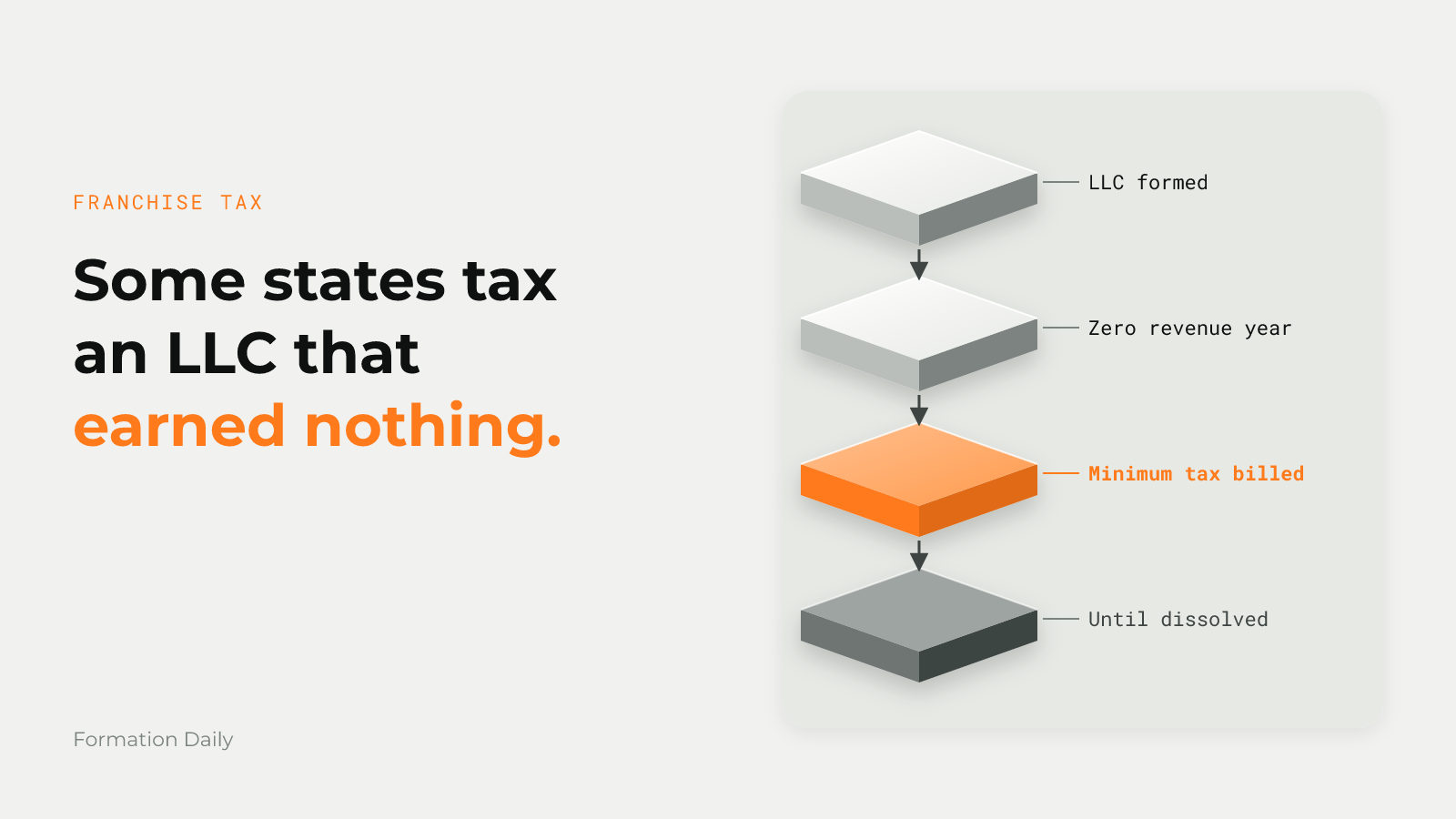
Five of the seven states our desk checked on October 19 send an LLC a bill for a year in which it earned nothing. Each figure traces to a state page or bill record.
We built this comparison of LLC franchise tax by state from the pages of California, Texas, Delaware, Tennessee, Arkansas, Wyoming and New York.
The bill arrives whether or not the company opened a bank account, signed a client or sent an invoice. For a founder planning the first year, the state minimum is the fixed price of keeping the entity on the public record.
The floors run from sixty dollars in Wyoming to eight hundred dollars in California, before any penalty or income-based charge.
Texas works the other way and charges no franchise tax at or below a revenue threshold of $2.65 million for reports due this year and next. The state still wants a report each May. A missed report can leave the owners personally liable for certain company debts once the entity forfeits its right to do business.
Which states charge an LLC that earned nothing?
California, Delaware, Tennessee, Arkansas and Wyoming each set a minimum that does not depend on income. Only New York and Texas let a quiet LLC pay nothing. Each of the two attaches a condition to the zero.
California ties its annual tax to organizing, registering or doing business in the state, not to sales or profit. The Franchise Tax Board’s LLC page puts the rule in one line: “Every LLC that is doing business or organized in California must pay an annual tax of $800.”
The same FTB page answers the case of a company that never traded: “This yearly tax will be due, even if you are not conducting business, until you cancel your LLC.”
Tennessee reaches the same result through a franchise tax measured on net worth rather than on income. Its Department of Revenue says the hundred-dollar minimum is payable by any LLC registered through the Secretary of State, “regardless of whether the company is active or inactive.”
Arkansas charges every LLC a flat hundred and fifty dollars. It is paid with the annual report by May 1. The Secretary of State adds that revocation does not stop the meter: “Franchise taxes continue to accrue, even for revoked businesses, until the business is dissolved, withdrawn, or merged.”
Wyoming is the fifth: its annual report license tax starts at sixty dollars even for an LLC with no assets in the state, and the asset formula can only raise that figure.
For an LLC formed to hold a domain, a lease option or a deal still in negotiation, these five states turn an idle year into a recurring cost. In California and Arkansas only a filed cancellation, dissolution or merger ends it.
How does the California LLC 800 fee work in the first year?
The first payment of the California LLC 800 fee falls due by the 15th day of the fourth month after the LLC files with the Secretary of State. Each later year follows the same fourth-month rule.
Payment goes through Web Pay, by credit card, or by mail with voucher FTB 3522.
A first-year waiver for LLCs formed in the three years through 2023 has expired, although the FTB page still lists it. One exit remains open on the same page: an LLC cancelled within a year of organizing, by the Secretary of State’s short form, is not charged for its first tax year.
The next change is already law: Senate Bill 122 was chaptered at the end of June this year, according to the bill record published by CalMatters’ Digital Democracy.
The Legislative Counsel’s digest on that record says the bill would “reduce the amount of the annual tax imposed on a limited partnership, limited liability partnership, and limited liability company” for the first taxable year. The cut is from eight hundred to four hundred dollars. It covers first taxable years beginning in 2027 through 2029.
Timing decides who gets the lower amount: on our reading of the digest, an LLC organized this December starts its first taxable year before the window opens and pays the full eight hundred.
A second California charge, the LLC fee, starts once revenue passes a quarter of a million dollars. The FTB says it plainly: “If your LLC will make more than $250,000, you will have to pay a fee.” Form FTB 3536 carries the estimate by the sixth month.
The bands climb from nine hundred dollars to $11,790 for total California income of five million dollars or more.
The FTB requires an LLC to use the same tax classification for California as for federal purposes. A single-member LLC disregarded by the IRS is disregarded in California too and still owes the annual tax. Its annual return is Form 568.
What does Texas franchise tax no tax due mean for a new LLC?
In Texas the phrase means no tax and no franchise tax report, but it does not mean no filing at all. The Comptroller lists LLCs, single-member LLCs and series LLCs as taxable entities whether they are formed in Texas or only doing business there.
The rule changed for reports due in 2024, after the legislature passed Senate Bill 3 in July of the prior year. The Comptroller’s overview describes the result: “taxable entities with total revenue at or below the no tax due threshold are no longer required to file a Franchise Tax Report but must continue to file an information report each year.”
The old form is gone, and on the discontinued No Tax Due Information Report the Comptroller states: “The form is not available for any new reporting periods.”
An LLC files Form 05-102 as its information report. It is due with the annual report on May 15. Weekends and holidays push it to the next business day.
Officer and director details from that report appear in the Comptroller’s online Taxable Entity Search.
Above the threshold, the rate is three-quarters of one per cent of taxable margin, and retail and wholesale businesses pay half that rate. Margin can be computed as seventy per cent of total revenue, as revenue minus cost of goods sold, as revenue minus compensation, or as revenue minus one million dollars.
The Comptroller’s franchise tax page lists forfeiture notices dated July and August 2026 for entities that missed their filings. For an entity at or below the threshold, the page says the fix is to file the missing Public Information Report.
Skipping the report costs more than any tax: after forfeiture, the Comptroller says, “each officer, director, partner, member or owner becomes personally liable for certain debts of the entity.”
One group is excused from both filings for a time. The Comptroller says a qualifying new veteran-owned business files neither a No Tax Due Report nor an information report during its initial five-year period.
How much does Delaware charge an LLC each year?
Delaware charges a flat annual tax and asks for no annual report from an LLC. The Division of Corporations’ page for LLCs, LPs and GPs says they “must pay the $400 yearly tax on or before June 1st” for the prior year.
The tax does not shrink for a short year, and the Division states it directly: “There is no proration on alternative entity taxes.”
The Division assesses the tax if the entity is active on its records at any point in the calendar year. An LLC formed in December therefore owes a full year.
Late payment adds a penalty of two hundred dollars. Interest of one and a half per cent a month runs on the tax and the penalty together. Payments above five thousand dollars must go by ACH debit.
Delaware’s Division also warns about deceptive solicitations and tells entities to treat with suspicion any correspondence that does not come from the State or from their Delaware registered agent.
A Delaware corporation runs on a different calendar. Its annual report and franchise tax are due by March 1, with a minimum tax of $175 under the authorized shares method plus a fifty-dollar filing fee for a non-exempt company.
Which states base the bill on net worth, assets or income?
Tennessee, Wyoming and New York each scale the charge to the size of the company. Assets, net worth or income set the amount.
Tennessee measures franchise tax on net worth apportioned to the state at a quarter of one per cent, with the hundred-dollar floor, and it levies a separate excise tax on net earnings.
Wyoming collects its charge through the annual report filing. The Business Division’s fee schedule sets the license tax at the greater of sixty dollars or two-tenths of one mill on the dollar of assets located and employed in Wyoming.
New York measures the fee on gross income. Its tax department charges an LLC taxed as a partnership a filing fee on Form IT-204-LL.
The fee follows New York source gross income of the preceding year and runs from $25 to $4,500. The top band starts above twenty-five million dollars.
A single-member LLC disregarded for federal purposes pays a flat twenty-five dollars when it has any New York source items.
A dormant LLC is excused from the fee and the form altogether in New York, a rule we did not find in the other six states. The department lists among non-filers an LLC with no income, gain, loss or deduction from New York sources in the current year, even one formed under New York law.
The deadline does not move for this form. It is due on the 15th day of the third month after the tax year closes. The department adds: “There is no extension of time allowed to file Form IT-204-LL or to pay the fee.”
What happens when an LLC misses the payment?
Every state in the sample adds a penalty. Two of them can also take away the company’s standing. Texas can forfeit an entity’s right to transact business, and Arkansas can revoke its authorization to do business while the tax keeps accruing.
California pairs the annual tax with a second duty, the Statement of Information filed with the Secretary of State. The FTB collects that office’s charge. Its LLC page warns: “SOS imposes a $250 penalty if you do not file your Statement of Information.”
That penalty alone is nearly a third of the tax.
A suspended LLC also loses the FTB’s automatic filing extension.
Texas adds a fifty-dollar penalty for each late report. Unpaid tax draws a further five per cent penalty when it arrives within thirty days of the due date and ten per cent when it arrives later, on the Comptroller’s schedule.
Arkansas goes further than a fee, because its statute bars any additional business filings from an entity that fails to pay its franchise tax, so even an amendment waits there until the tax is paid.
Delaware applies its two-hundred-dollar penalty plus monthly interest. A late LLC also stays on the Division’s tax roll for every calendar year it remains active.
What does the data not show?
Our desk read seven states for this comparison, so the other forty-three and any city or county business taxes sit outside it. Annual report fees charged elsewhere are a separate budget line.
The California sources give different answers for 2027. The FTB’s LLC page, last updated this March, still shows eight hundred dollars, makes no reference to the new law and links only this year’s voucher.
The Texas threshold also moves, because the Comptroller publishes it mostly in two-year pairs, and the page shows no figure yet for reports due after next year, so a budget for later years rests on an estimate.
We did not read Tennessee’s excise tax rate or the New York rules for an LLC taxed as a corporation. Each needs its own check before anyone budgets on it.
How should LLC franchise tax by state shape a first-year budget?
Our minimum list of LLC franchise tax by state for a dormant year reads: Wyoming $60, Tennessee $100, Arkansas $150, Delaware $400 and California $800. Texas and New York sit at zero when their conditions are met.
Those amounts stack when an LLC is formed in one state and works in another, because the FTB’s test covers an LLC doing business in California as well as one organized there. A Delaware LLC operating in California owes both annual amounts.
An accountant confirms the reader’s own case before any payment. The answer turns on the tax year, the in-state activity and the entity’s federal classification. Each state applies its own test of doing business.
Formation Daily’s view is that the minimum tax belongs in the formation budget on day one, next to the filing fee. A Texas zero still needs a report. A December Delaware LLC still pays a full year.
A California LLC whose first taxable year begins in 2027 may start at half price.
We will check the FTB pages again when the Board publishes its forms for the 2027 tax year and update the California figures here. Until its own LLC page shows the reduced amount, the statute and the agency page disagree, so a company timing its launch around that window needs its preparer’s answer on which figure the FTB will apply.
Sources
- California Franchise Tax Board, Limited liability company ftb.ca.gov.
- CalMatters Digital Democracy, SB 122: Taxation (chaptered text and Legislative Counsel’s digest) calmatters.digitaldemocracy.org.
- Texas Comptroller of Public Accounts, Franchise Tax comptroller.texas.gov.
- Texas Comptroller of Public Accounts, No Tax Due Reporting for Report Year 2024 and Later comptroller.texas.gov.
- Texas Comptroller of Public Accounts, Franchise Tax Overview comptroller.texas.gov.
- Texas Comptroller of Public Accounts, Public Information Report and Ownership Information Report comptroller.texas.gov.
- Delaware Division of Corporations, LLC/LP/GP Franchise Tax Instructions corp.delaware.gov.
- Delaware Division of Corporations, Annual Report and Tax Instructions corp.delaware.gov.
- Tennessee Department of Revenue, Franchise and Excise Tax tn.gov.
- Tennessee Department of Revenue, FT-1 Franchise Tax Computation revenue.support.tn.gov.
- Arkansas Secretary of State, Franchise Tax and Annual Report Forms sos.arkansas.gov.
- Arkansas Secretary of State, Annual LLC Franchise Tax Report 2026 sos.arkansas.gov.
- Wyoming Secretary of State, Business Division Filing Fee Schedule sos.wyo.gov.
- New York State Department of Taxation and Finance, Partnership, LLC, and LLP annual filing fee tax.ny.gov.