How to Transfer Ownership of an LLC: Agreement, EIN and Bank
Selling or gifting an LLC interest runs through the operating agreement and state LLC act first. Our desk maps the IRS, gift tax and bank steps that follow.
Owners who ask our desk how to transfer ownership of an LLC usually expect a state form with a fee and a deadline. The first answer sits somewhere else. It sits in the company’s operating agreement and in the LLC act of the state of formation, and both come before any form the state keeps on file.
Many of those acts follow the Revised Uniform Limited Liability Company Act, the model the Uniform Law Commission drafted in 2006 and amended in 2013. Iowa and Minnesota both enacted versions of it. Our research team compared their transfer and membership sections line by line, then checked the federal pages that come into play once a sale or gift closes, from the EIN rules to the gift tax return.
The comparison matters for a plain reason. A sale or gift can be complete between the parties while the public register shows no change, and the proof then lives only in the company’s own papers.
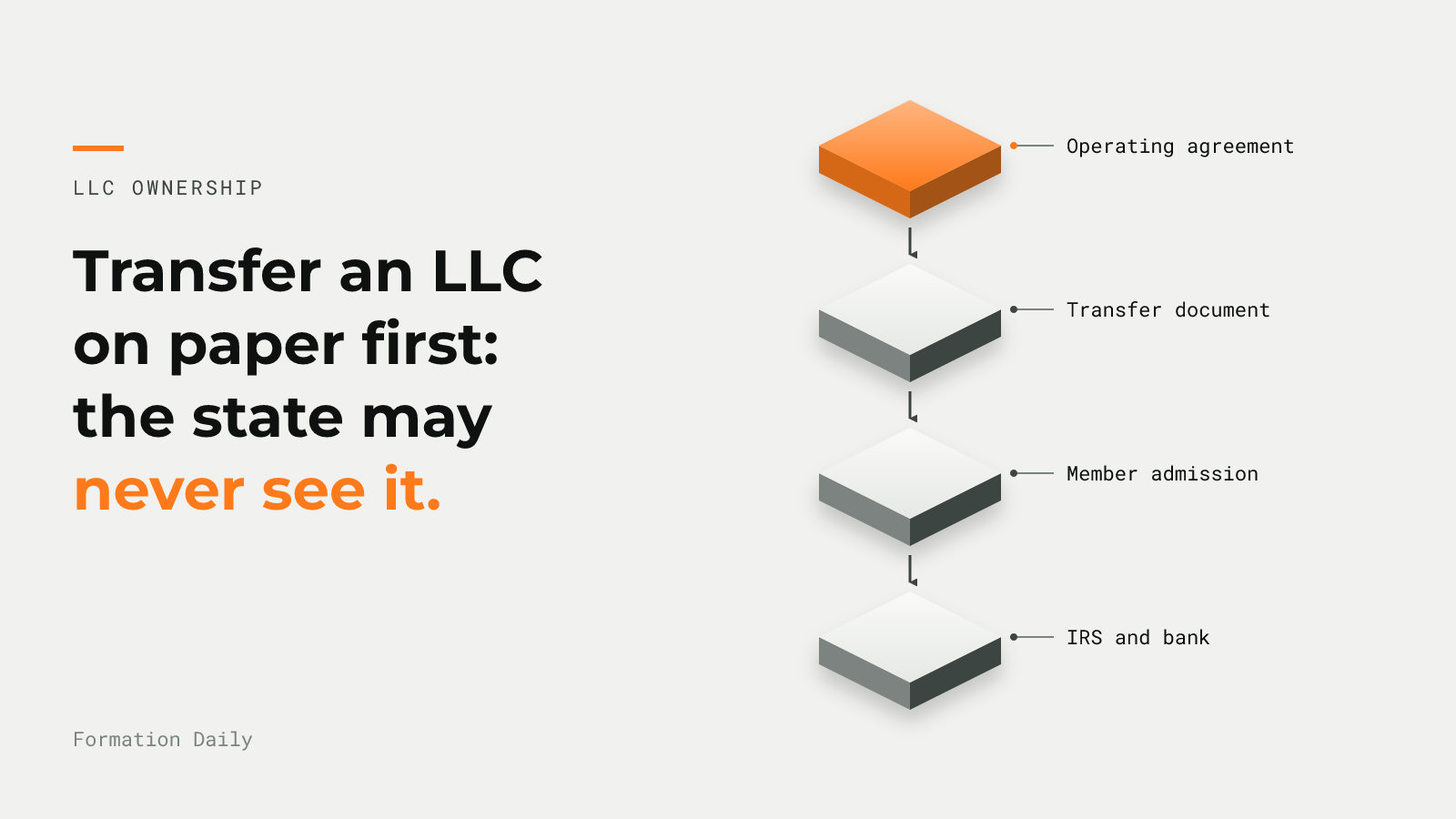
We order the work by record. The operating agreement comes first, followed by the transfer document, the admission of the new member, the IRS file and the bank file. Federal deadlines attach to the IRS records.
How to transfer ownership of an LLC when the state never sees it?
The transfer runs on private documents, and the state register changes only where that state’s forms ask for owner data. Minnesota’s formation section shows how that works.
Chapter 322C gives the uniform act Minnesota’s own title. Its articles of organization state the company name and the registered office, plus "the name and street address of each organizer." Members are absent from the list.
A later sale therefore leaves the filed articles accurate as written, even after every original owner has left and a new group of members runs the company from a different address under the same filing. So does an ownership change need a state filing? At the articles stage, Minnesota’s required list gives no reason for one, because it never names a member.
Formation documents also carry different names across states. Our note on how a certificate of formation differs from articles of organization sets out that naming split and what each filing holds.
Proof becomes the owner’s problem the day a buyer, a lender or a court asks for it, and each of them will want the signed assignment, the members’ consent and the updated member schedule. None of those papers sits in a public file.
The IRS uses the same vocabulary as the statutes, and its LLC page states that "Owners of an LLC are called members." Under the uniform text, though, membership is a legal status the act controls. A person can hold an economic stake in the company without holding that status, and the rest of a transfer is built around the difference between the two.
What does the operating agreement decide before any state rule applies?
The operating agreement decides first in every transfer. The act then enforces whatever transfer limits the members wrote into it, and disputes over a sale often start with a clause nobody reread before signing.
Iowa’s code accepts an operating agreement "whether oral, in a record, implied, or in any combination thereof." Unsigned terms can bind. Conduct, emails and past distributions supply those terms. A buyer who relies on the absence of a written agreement takes on that uncertainty along with the interest.
Transfer restrictions carry real weight under the uniform text. Iowa’s transfer section says a transfer made against a restriction in the agreement "is ineffective as to a person having notice of the restriction at the time of transfer."
A buyer who read the agreement has notice. That buyer takes the interest subject to any consent requirement, right of first refusal or price formula the agreement contains, whatever the purchase contract between seller and buyer says about it.
We recommend reading the clauses on consent to transfer, admission of new members, purchase rights of the other members and the effect of a member’s death before any talk of price. Where the agreement is silent, the statute’s default applies.
Owners most often skip the clause on death. Iowa’s code lets a deceased member’s personal or legal representative exercise the rights of a transferee, along with some member rights needed to settle the estate, but the estate does not become a full member by that route.
Certificates of interest add one more paper to track. Minnesota lets a company evidence a transferable interest with a certificate it issues, and the interest can then pass by transfer of that certificate, so a company that issued one cancels and reissues it at closing.
Does selling an LLC membership interest make the buyer a member?
By default, selling an LLC membership interest moves the economic rights and leaves membership behind. Admission is a separate act under the uniform text.
Iowa’s version spells out the default effects of a transfer, starting with the rule that a transfer is permissible and does not by itself end the seller’s membership in the company. It gives the transferee no right to take part in management and, with narrow exceptions, no right to see the company’s records either.
After a partial sale, the seller keeps a residual position. Iowa’s code says the transferor "retains the rights of a member other than the interest in distributions transferred." The same subsection keeps the seller bound by a member’s duties.
So the buyer collects distributions while the seller keeps the vote, the information rights and the obligations that come with membership. Only an admission document gives the buyer a vote.
A hypothetical case shows how the default plays out. One member of a two-member company sells part of her interest to an outside buyer, and nobody signs an admission consent. The buyer receives that share of distributions. She still votes her full stake, and the other member was never even asked.
Iowa’s section on members lists the routes to admission. It opens: "After formation of a limited liability company, a person becomes a member upon any of the following:" The routes include a provision in the operating agreement, a merger or similar transaction, and the consent of all members.
Minnesota uses the same routes and adds a rule for a company left with no members at all, and unless the agreement or a merger supplies another path, both codes require every member to agree before an outsider joins.
Minnesota also sets a notice rule. A company need not give effect to a transferee’s rights until it has notice of the transfer, so the buyer delivers the assignment to the company and records the date it was delivered.
Selling the whole interest raises the question of exit. Iowa lets the remaining members expel, by unanimous consent, a person who has transferred all of his or her transferable interest.
A closing set that tracks the statute holds an assignment of the interest, a written consent admitting the buyer, and an amended schedule of members with their percentages.
How does gifting LLC shares to family work with the gift tax?
Gifting LLC shares to family follows the same statutory transfer rules. Federal gift tax law then adds valuation and reporting on top, and the uniform text we read sets no separate path for relatives.
In the IRS gift tax FAQ, a gift is "Any transfer to an individual, either directly or indirectly," made without full consideration in return. An LLC interest handed to a child for no payment fits that definition.
For 2026, the FAQ lists an annual exclusion of nineteen thousand dollars per recipient. Gifts to one person above that figure in a year generally require a return. The donor, not the recipient, generally pays any tax due.
Valuation is the hard part for a private company. The Form 709 instructions put the value at fair market value on the date of the gift, and an LLC interest has no quoted market price to borrow from an exchange or a dealer.
The instructions include a line written for entity interests: "If you transfer any interest in a closely held entity, provide the EIN of the entity." The company’s number thus appears on the donor’s personal return.
Disclosure decides how long the IRS can revisit the value. The instructions tie the limitations period to adequate disclosure: a description of the property, plus either a qualified appraisal or a detailed account of the valuation method the donor used.
The return is due by April 15 of the following year. A weekend or legal holiday moves that deadline to the next business day, so a gift signed this year points to a return due next spring.
On the company side, a gifted interest without admission leaves the relative with distributions and no vote. Families planning a full handover put the members’ consent to admission in the same file as the assignment.
Does the LLC need a new EIN after an ownership change?
The EIN usually stays when the same entity survives the sale. The IRS ties a new number to a change in the entity or its structure, and its page on new EINs sorts the cases by entity type, from sole proprietors to corporations.
Partnerships get the clearest line on the page. No new number is needed when the owners "Undergo a change in ownership that does not result in the termination of the partnership." A multi-member LLC taxed as a partnership falls under that heading.
Under its LLC heading, the same page requires a new number where owners "Terminate an existing LLC and form a new corporation or partnership." A sale that keeps the LLC in place does not match that line.
A one-owner LLC that sells part of its interest faces a harder question. The IRS single-member LLC page treats such a company as disregarded by default. It adds that "A domestic LLC with at least two members is classified as a partnership for federal income tax purposes".
Once a second member arrives, the company’s income moves off the owner’s own schedules and onto a partnership return. The IRS pages we opened are silent on whether the existing EIN carries over in that conversion. Our desk sends that question to the accountant before closing.
Control carries its own federal deadline. The Form 8822-B page states: "Changes in responsible parties must be reported to the IRS within 60 days." The responsible party is the individual the IRS links to the EIN, and a seller who leaves without that filing stays on the IRS record for an entity he or she no longer controls.
Beneficial ownership reporting has dropped off the list for domestic LLCs. FinCEN’s interim final rule exempted companies created in the United States. Its page says a final rule issued in August 2026 made those exemptions permanent.
What does the bank need to see after the owners change?
The bank needs the identities of the new owners. FinCEN’s customer due diligence regulation makes a covered bank identify the people behind each business customer, and an ownership change moves exactly those people.
Under that regulation, a covered bank keeps written procedures to identify and verify the beneficial owners of each legal entity customer when it opens a new account. The ownership prong reaches each individual who "owns 25 percent or more of the equity interests of a legal entity customer".
Control forms the second prong of the test. It covers a single individual with significant responsibility to control, manage or direct the company, and the regulation’s own examples include a managing member. A buyer who becomes manager fits that test, whatever the stake.
The regulation ties beneficial owner identification to account opening. For an existing account, the bank’s account agreement and change forms govern the update after a sale, and those documents differ from bank to bank.
Signing authority is a separate record at the bank. A departing seller can remain an authorized signer on the company account until a members’ resolution and the bank’s own forms remove that authority, so the resolution belongs in the closing file next to the assignment.
Our bank packet holds the assignment, the admission consent, the updated member schedule and a resolution naming the new signers, and the bank confirms whether its forms need anything more.
Some buyers also move the account after closing. The Bank Index compares banks and payment providers against a business’s needs, and the receiving bank then runs its own identification from the start.
What do the statutes and IRS pages leave open?
Our sources cover the uniform model, the Iowa and Minnesota enactments and federal guidance. Questions beyond those pages stay open. Delaware and other states outside the uniform model write their own transfer and admission defaults, so a Delaware company needs its own reading of the state code, clause by clause, against its own operating agreement.
The Iowa and Minnesota sections we cite describe articles of organization only, and annual report content varies by state, with some yearly forms that may ask for manager or member names. Our desk did not survey those forms.
Income tax on a sale falls outside these pages. The seller’s gain, the buyer’s basis and the partnership’s allocations turn on facts the statutes leave untouched.
Gift valuation for a private company stays open as well. The instructions ask for fair market value and adequate disclosure without fixing a method for a minority stake in a private LLC.
Each owner’s case still needs review by specialists. An attorney admitted in the state of formation confirms how the act and the agreement apply to the deal. The accountant confirms the EIN position and any partnership or gift return, and the bank confirms its own document list for the account.
What should the closing file contain?
The closing file holds the transfer and admission documents first, followed by the IRS and bank updates in date order. In our view, the operating agreement is the document to amend before any money moves.
Under both state codes we read, a sale or gift without an admission consent leaves the new holder with distributions and no vote. Sometimes that outcome is exactly the intent. A family gift of economic rights only is one example, and the documents then need to say so plainly.
Federal deadlines run alongside the private paperwork. A responsible party change carries a sixty-day reporting limit, and a gift return above the exclusion falls due in April of the following year.
Owners selling an LLC membership interest or gifting LLC shares to family can build the file in that order and send it to the accountant and the bank together. As our desk reviews annual report forms, we will add state notes on which ones list members.
Sources
- Iowa Code chapter 489, Iowa’s uniform LLC act legis.iowa.gov.
- Minnesota Statutes 322C.0101, short title of chapter 322C revisor.mn.gov.
- Minnesota Statutes 322C.0201, Articles of organization revisor.mn.gov.
- Minnesota Statutes 322C.0401, Becoming a member revisor.mn.gov.
- Minnesota Statutes 322C.0502, Transfer of transferable interest revisor.mn.gov.
- Uniform Limited Liability Company Act (2006, last amended 2013), National Conference of Commissioners on Uniform State Laws bia.gov.
- IRS, page on when a new EIN is needed irs.gov.
- IRS, Single member limited liability companies irs.gov.
- IRS, Limited liability company (LLC) irs.gov.
- IRS, About Form 8822-B irs.gov.
- IRS, Gift tax FAQ irs.gov.
- IRS, Instructions for Form 709 irs.gov.
- FinCEN, Beneficial ownership information reporting fincen.gov.
- 31 CFR 1010.230, Beneficial ownership requirements for legal entity customers law.cornell.edu.