LLC vs Sole Proprietorship: Liability, Tax and Bank Rules
An LLC and a sole proprietorship can file the same federal return. Liability, deposit insurance, bank onboarding and state fees are where they split.
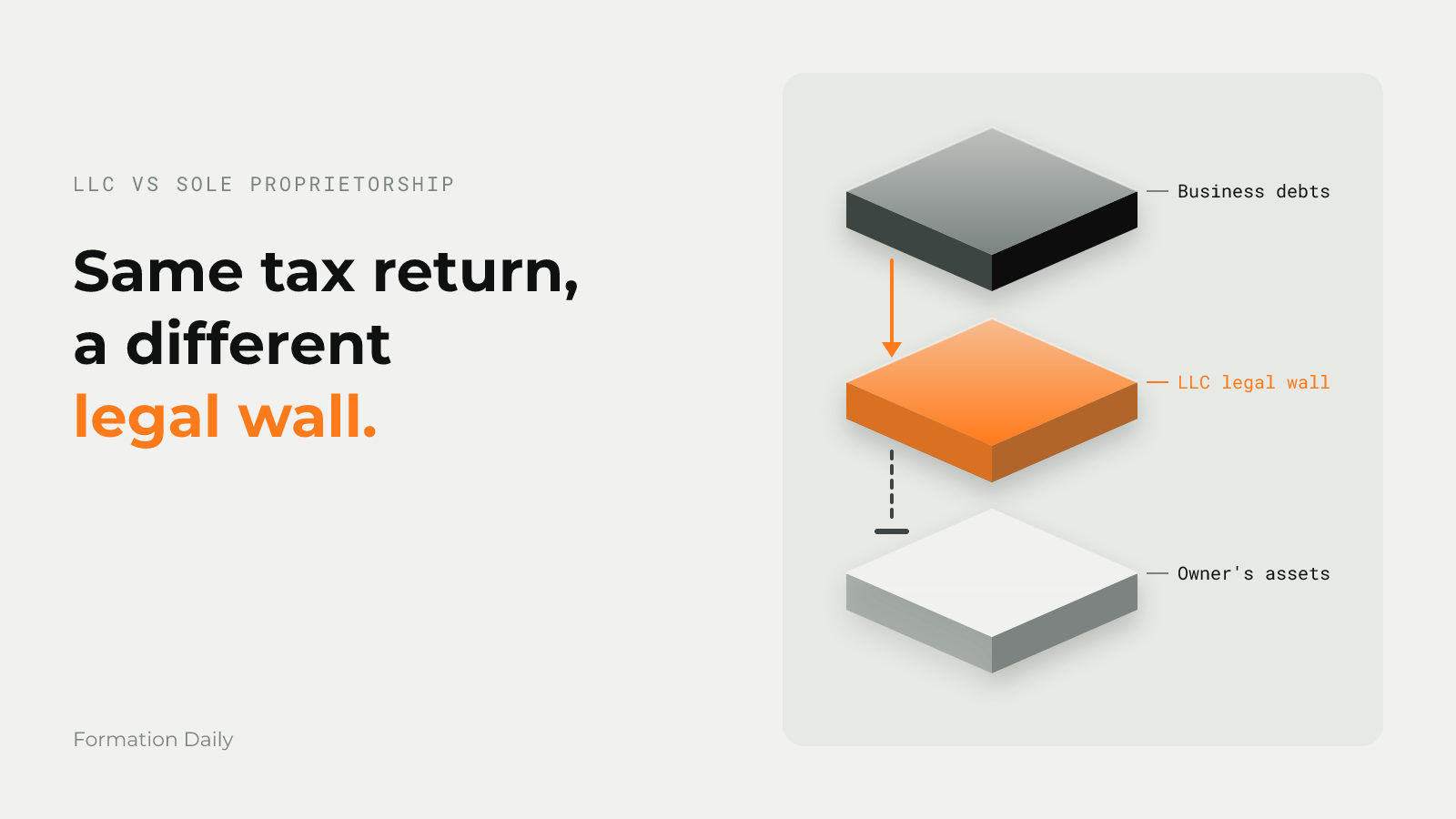
The LLC vs sole proprietorship choice is often framed as a tax decision. For a one-owner business with default tax treatment, it mostly is not. Federal income tax comes out the same. The differences sit in liability, in banking, in deposit insurance and in what the state charges every year, and each of those can cost an owner more over a decade than any tax saving a structure is supposed to bring.
Our research team set the two structures side by side using primary sources only: the IRS business structure pages, the SBA guide, the Delaware LLC Act, FDIC guidance, the federal customer due diligence rule and fee pages from three states. No reseller price lists.
Our short answer comes first. A sole proprietorship costs nothing to start and offers no separation. A single-member LLC costs a filing fee and an annual charge, files the same federal return by default, and buys a legal wall. That wall holds only if the owner keeps the money and contracts in the LLC’s name.
LLC vs sole proprietorship: what exists on day one?
A sole proprietorship exists as soon as one person does business without registering anything else. An LLC exists only after a state accepts a formation filing.
Federal small business guidance states the default plainly. Anyone who does business without registering another structure is a sole proprietor automatically, according to the SBA. No state filing creates it. No state filing ends it either.
Tax law uses an equally short definition. The IRS page says: "A sole proprietor is someone who owns an unincorporated business by themselves." The key word is unincorporated. The business and the person are one legal person.
That has a direct consequence, spelled out by the SBA: a sole proprietorship produces no separate business entity, so business assets and debts are the owner’s own. A trade name can be registered, and the SBA notes that sole proprietors can get one, but a trade name is a label, not an entity.
An LLC is different in kind. Federal banking rules capture that difference precisely. The customer due diligence rule defines a legal entity customer as "a corporation, limited liability company, or other entity that is created by the filing of a public document with a Secretary of State or similar office." The public filing is what creates the LLC.
How does LLC liability protection work, and where does it stop?
LLC liability protection means the company’s debts are the company’s. A member is not liable for them simply because of being a member. That is the full scope of the rule.
Delaware’s LLC Act is a clear example. Under section 18-303, "no member or manager of a limited liability company shall be obligated personally for any such debt, obligation or liability of the limited liability company solely by reason of being a member or acting as a manager." Other states use similar wording in their own acts.
Two words carry the weight: solely by reason. The statute protects status. It does not protect conduct. An owner who personally causes harm, or personally signs for a debt, can still be liable for that act or that promise.
Owners can also give the protection away, under the same section. Subsection (b) says "a member or manager may agree to be obligated personally for any or all of the debts, obligations and liabilities of the limited liability company." A personal guarantee on a loan, a lease or a card is exactly such an agreement.
Signature blocks matter for the same reason. A contract signed by the owner personally, with no company name or title, can be read as a personal promise. Signing with the LLC’s full legal name and the owner’s title keeps the obligation with the company. Invoices, quotes and the website footer should carry the same legal name.
That is why many small LLC owners carry the same exposure on their main debts as a sole proprietor would. The wall stands for unplanned claims. It does not stand for the debts the owner signed for.
Small business guidance describes the benefit with a careful qualifier. The SBA guide says: "LLCs protect you from personal liability in most instances." Those last three words are not decoration. The exceptions come from state law and court decisions, and different answers are possible from one state to the next.
A sole proprietorship has no wall at all. On that point the SBA is blunt: "You can be held personally liable for the debts and obligations of the business." Insurance is the only buffer.
Sole proprietor vs single member LLC: is the federal tax different?
By default, no. A single-member LLC that makes no election is taxed exactly like a sole proprietorship.
The default comes from the IRS LLC page: "For income tax purposes, an LLC with only one member is treated as an entity disregarded as separate from its owner." An election on Form 8832 can change that. Disregarded means the LLC files no separate income tax return.
The activity goes on the owner’s return instead. For an individual owner, it lists Schedule C among the forms, the same profit or loss schedule a sole proprietor files with Form 1040.
Self-employment tax follows the same path. The IRS says: "An individual owner of a single-member LLC that operates a trade or business is subject to the tax on net earnings from self employment in the same manner as a sole proprietorship."
Rates match as well. The IRS self-employment tax page sets the rate at 15.3 per cent, made of a social security part and a Medicare part. For 2026, the social security part applies to the first 184,500 dollars of combined earnings.
So in the sole proprietor vs single member LLC comparison, the federal tax line is a tie unless the LLC elects corporate treatment. An S corporation election is the usual reason owners make that change. It belongs in a separate analysis with a deadline of its own.
When does a single-member LLC need its own EIN?
When it has employees, owes certain excise taxes, or needs one for a bank. The IRS treats the LLC as separate for those purposes even when it is disregarded for income tax.
That split is stated directly on the IRS LLC page: "However, for purposes of employment tax and certain excise taxes, an LLC with only one member is still considered a separate entity." Payroll for an LLC runs under the LLC’s own EIN.
A sole proprietor with no employees can usually operate on a Social Security number. A single-member LLC with no employees can do the same for federal tax, using the owner’s number on information returns.
Banks change that calculation in practice. The IRS single-member LLC page says an LLC can obtain an EIN if it needs one to open a bank account, and adds: "Most new single-member LLCs classified as disregarded entities will need to obtain an EIN." We read that as the IRS acknowledging the practical norm.
A W-9 is the trap here. For a disregarded LLC, the IRS page says the W-9 should show the owner’s SSN or EIN, not the LLC’s EIN. Clients who ask an LLC for a W-9 receive the owner’s number by default.
How do banks and the FDIC treat each structure?
The FDIC insures an LLC’s deposits separately from its owner’s personal deposits. It insures a sole proprietorship’s deposits together with them. That is the most concrete banking difference between the two.
Deposit insurance guidance for bank employees is explicit about sole proprietors: "Sole proprietorship accounts are insured as the single accounts of the owner." The guide adds that such accounts are combined with the owner’s other single accounts at the same bank and insured up to the standard maximum.
That standard maximum is 250,000 dollars per depositor, per bank, per ownership category, and owners who split money across several accounts at the same bank in the same category gain no extra coverage from doing so. It is not per account. For a sole proprietor, the business checking balance and the personal savings at the same bank share that one limit.
A hypothetical example shows the gap. An owner keeps 180,000 dollars in business checking and 120,000 in personal savings at one bank. As a sole proprietor, the owner has 300,000 dollars in a single category, so part of it sits above the limit. Held by an LLC with a real business purpose, the business balance is insured on its own and the personal savings separately.
An LLC sits in the corporation, partnership and unincorporated association category. The guide insures those accounts up to the same amount only if the entity is engaged in an independent activity, defined in the guide as operating primarily for a legitimate business purpose and not solely to increase deposit insurance coverage. An operating business with real customers is the case that definition describes.
Onboarding differs too, and it takes longer for the LLC. A bank opening an LLC account follows the beneficial ownership rule. It identifies the people who own or control the company. A sole proprietor’s account is opened in the owner’s own name, often with a trade name attached.
For owners, the practical outcome is simple. Mixing personal and business money is normal in a sole proprietorship and corrosive in an LLC. Separate accounts are part of keeping the liability wall standing.
What does each structure cost in state fees?
A sole proprietorship has no state formation fee. An LLC pays at formation and, in most states, every year after. The annual charge is usually the larger number over time.
California shows the high end, even though the bill starts small. The Secretary of State charges 70 dollars for the Articles of Organization and 20 dollars for the Statement of Information, due within 90 days and every two years after. The Franchise Tax Board adds the annual tax.
On that tax, the Franchise Tax Board page leaves no room for interpretation: "Every LLC that is doing business or organized in California must pay an annual tax of $800." The page adds: "This yearly tax will be due, even if you are not conducting business, until you cancel your LLC." Dormant LLCs pay too.
California also charges a separate LLC fee once California income reaches 250,000 dollars. The first tier is 900 dollars, and the tiers rise with income.
Delaware’s annual tax for LLCs is listed on its franchise tax instructions page at 400 dollars, due on or before June 1. A late payment adds a 200 dollar penalty plus monthly interest.
Wyoming sits at the low end of the three states we checked, although its annual charge grows with the value of company assets located and employed in Wyoming, so a capital-heavy business pays more than the minimum. Its fee schedule lists 100 dollars for Articles of Organization. The annual report license tax starts at 60 dollars.
A short aside on the other side of the ledger. A sole proprietor may still pay for a trade name filing, a local business licence or a professional licence. Those costs apply to both structures, so they rarely decide the choice.
The annual charge adds up quietly. Over five years, a hypothetical California LLC pays the 800 dollar tax five times plus its formation and Statement of Information fees, so the total passes four thousand dollars before any professional help is bought. A sole proprietor in the same city pays none of it.
Which structure fits which business?
Federal guidance offers a reasonable starting point. The SBA presents the sole proprietorship as a fit for low-risk businesses and for owners testing an idea before forming a more formal business.
For LLCs, the same guide points to risk and assets. It says LLCs "can be a good choice for medium- or higher-risk businesses, owners with significant personal assets they want protected" and owners comparing tax rates with a corporation.
We add our own practical questions. Does the business sign contracts, leases or loans that a customer or landlord could enforce? Does it hold inventory, employ people or work on other people’s property? Does the owner have savings or a home that a judgment could reach?
Any yes points toward an LLC, alongside adequate insurance. A freelancer testing demand with a few clients and no premises can reasonably start as a sole proprietor and convert later, once contracts, staff or savings give a creditor something worth pursuing and the annual fee starts to look small.
Conversion is a filing, not a rebuild. It still takes work. The bank account, the EIN and contracts usually have to move to the new entity, and each counterparty has to be told.
What the sources leave open
Federal pages settle tax and insurance well. They are silent on the real liability question. Would a court in a given state respect a particular owner’s LLC when a creditor argues that the company was only a label on the owner’s own affairs, with shared accounts, unsigned agreements and no separate records? That depends on facts and on state case law. No fee page or IRS page addresses it.
State fees also change. The Delaware figure we quote is the one on the state’s page as we read it this month. Older third-party guides may show other amounts. The state page is the one to trust.
The choice for a specific business belongs with an accountant for tax elections and a lawyer licensed in the state for liability. A bank can confirm what it needs to open the account for either structure.
Our view: for most owners with real customers, an LLC is cheap insurance on top of real insurance. It works only when run as a separate business. A sole proprietorship remains the honest choice for a test, and the cheapest one. The weakest setup is the middle path: an LLC on paper, with the owner’s personal account doing all the work.
Sources
- IRS: Sole proprietorships irs.gov.
- IRS: Limited liability company (LLC) irs.gov.
- IRS: Single member limited liability companies irs.gov.
- IRS: Self-employment tax (Social Security and Medicare taxes) irs.gov.
- SBA: Choose a business structure sba.gov.
- Delaware Code: Title 6, Chapter 18, Subchapter III, § 18-303 delcode.delaware.gov.
- FDIC: Financial institution employee’s guide, corporation, partnership and unincorporated association accounts fdic.gov.
- eCFR: 31 CFR 1010.230, Beneficial ownership requirements for legal entity customers ecfr.gov.
- California Secretary of State: Limited Liability Companies, California (Domestic) forms and fees sos.ca.gov.
- California Franchise Tax Board: Limited liability company ftb.ca.gov.
- Delaware Division of Corporations: LLC/LP/GP Franchise Tax Instructions corp.delaware.gov.
- Wyoming Secretary of State: Business Division Filing Fee Schedule sos.wyo.gov.